Bed, Surface or Universal: Three Ways to Mount a Lodestar ADVM
The short version
Measuring velocity
The Lodestar is a velocity sensor for canals and rivers, mounted at one point across the channel or at several. It uses sound to measure how fast water moves along one narrow beam. It comes in three versions: Lodestar-B on the canal floor looking up, for a firm floor that stays clear of silt, lined or not; Lodestar-S at the surface looking down, usually on a buoy, for silt or a soft bed; and Lodestar-U, a cylinder your installer's bracket holds on a wall or pier. Each needs a straight stretch where water runs evenly and parallel to the channel, and a mount that lifts it out for service. After service, a Lodestar looking up or down needs to go back only roughly where it was: its built-in 3D attitude sensor (tilt and compass) records the angle, and fine-tuning the angle settings from it offsets any slight change in tilt. HyFlow does not yet sell mounts or installation. This post covers canal installations.
Measuring area, from the water level
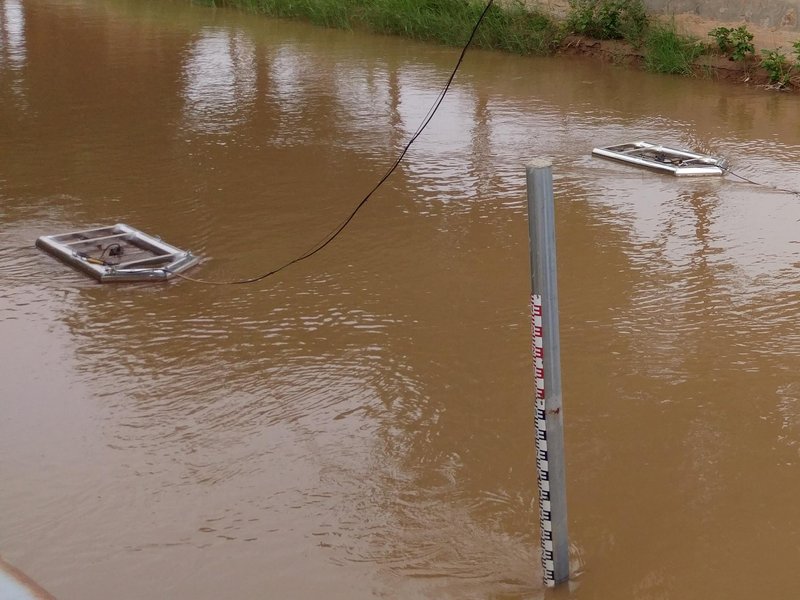
Velocity alone does not give flow; the area of flow is needed too. A separate water-level sensor measures the level, and the surveyed shape of the cross section turns it into area. Choose a stable, reliable water-level sensor; in canals with heavy silt or weed, a radar sensor above the water or a float in a stilling well needs less upkeep.
Mean velocity and flow
The Lodestar measures velocity layer by layer through the depth at each point where one is mounted, but that is not the channel's mean velocity. A gaging consultant, a specialist in measuring flow, measures the flow many times from low to high water (at least 10 measurements, in both directions where flow reverses) and builds the conversion chart, called a rating, from the Lodestar's reading, the index velocity, to the mean velocity. Mean velocity times area is the flow. The ratings are re-checked from time to time, and the cross section re-surveyed, to catch changes in the channel. The first post in this series explains the method.
Choose the stretch of canal first
The Lodestar is an acoustic Doppler velocity meter (ADVM) with one beam, and a beam reads only the water's motion along its line. So the beam must slant along the channel, toward upstream or downstream, never straight across the flow: "looking up" or "looking down" always means at a fixed slant, which the rating allows for. One beam also cannot tell motion along the channel from vertical or sideways motion, so the water must run parallel to the channel at every flow.
Published guidance on the index velocity method, the public method manuals hydrographers work from, describes the ideal site:
- straight for the greater of about 300 ft (90 m) or 5 to 10 channel widths each way;
- at least 5 to 10 widths from inflows, turnouts, gates and checks (structures that hold the canal level up);
- a stable bed, few weeds and little entrained air (bubbles);
- a place nearby to measure the flow at every water level, with no inflow or diversion between.
Backwater (water a check backs up the canal) can reach far upstream, so a backwater site can often keep that distance from its check. Where you must compromise, put evenly spread flow, parallel flow lines and a stable channel shape first.
Before installing, the same guidance calls for a site survey: map the velocities with a moving-boat ADCP (acoustic Doppler current profiler), then install the meter temporarily and study its record. A HyFlow Voyager is one such ADCP. Aim for the fastest water, clear of wall and pier wakes; in a straight, regular canal that is usually over the deepest part.
Check the geometry at the lowest water level. The transducer, the face that sends and receives sound, must stay submerged. Measurements start 0.05 m (2 in) from it, so there must be enough water beyond that for at least one valid cell, a short segment of beam in which the Lodestar measures velocity.
A firm bed that stays clear: bed mount
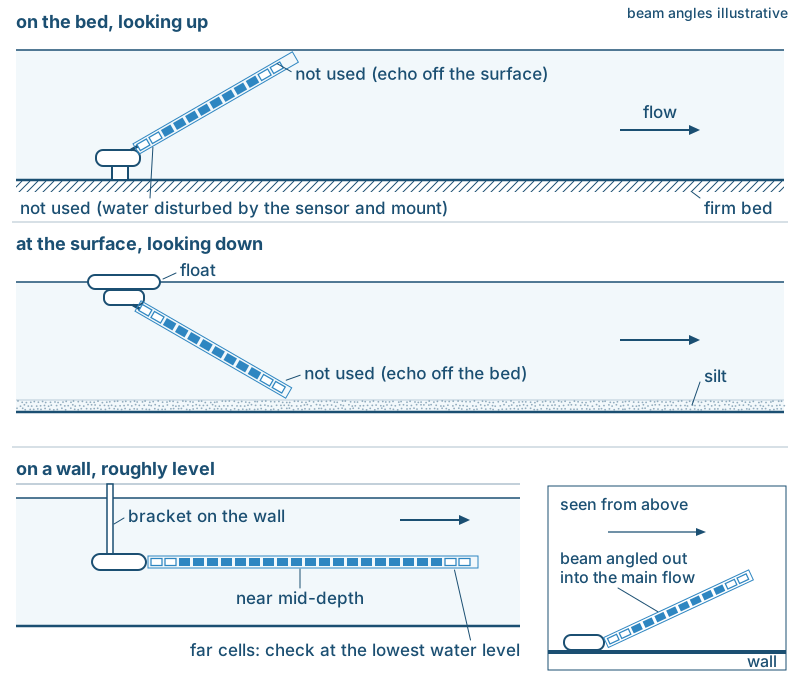
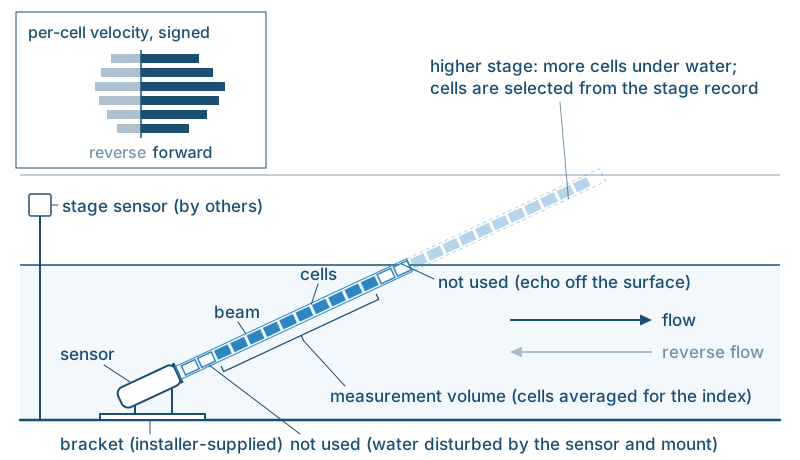
Where the bed is firm and stays clear of silt and moving sand, the Lodestar-B is the simple choice: a slant-face housing on the canal floor, its beam looking up into the water column (the water from bed to surface). The floor need not be concrete. The housing can be fixed to a lining, or set on a pedestal or post anchored in a firm earth, gravel or rock bed, raised a little to keep the transducer clear, at the cost of some measurable depth at low water.
The cells nearest the sensor can sit in water the sensor and its mount disturb and read slow or noisy, so the measurement volume (the cells that form the index velocity) starts beyond them. The cells just under the surface are spoiled by side lobes: like the faint glow around a flashlight's bright beam, weak sound off the beam's axis reaches the surface, which reflects far more strongly than the drifting particles whose echoes the Lodestar reads.
That spoiled zone moves with the water level, so your consultant picks the cells from the water-level record, as published guidance prefers for meters that look up from the bed. The index then covers the same part of the depth, such as the middle 60 percent, however high the water is, and stays clear of the spoiled cells.
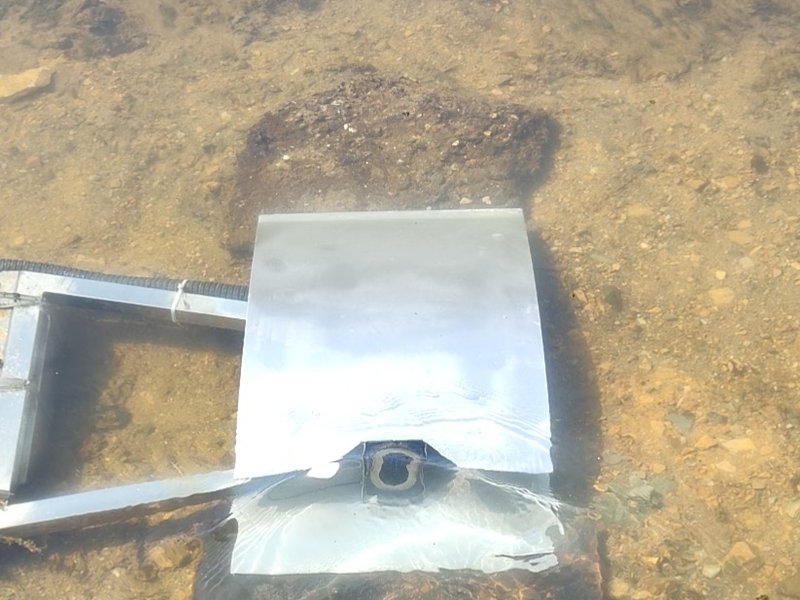
Our team's practice is to visit monthly or quarterly, to suit the site, with service before and after each high-flow season. Few districts can drain a canal mid-season, and a bed sensor is hardest to reach in a full canal. A hinged pole avoids draining the canal or sending a diver: the sensor sits at one end of a pole longer than the water is deep, hinged at the other end. For service it swings up out of the water and back down onto the same stop, raised by hand or by an inflatable float fixed to the pole. A streamlined weed cover, with the transducer facing downstream, saves further trips; why the Lodestar uses one beam explains how.
Silt or a soft bed: surface mount
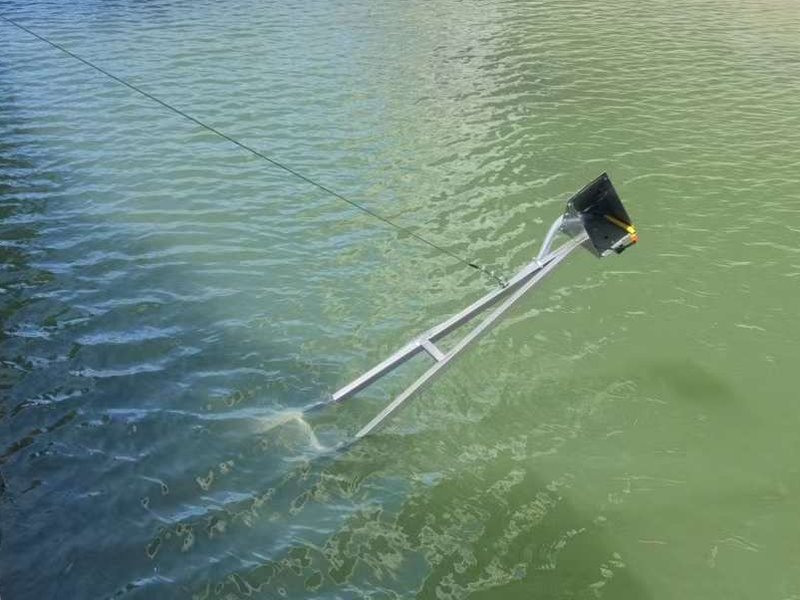
Where a canal carries silt or moving sand, or has a soft earthen bed, a meter on the bed can be buried or settle. The Lodestar-S looks down from the surface, with the transducer above the sediment. It usually rides on a float, anchored in place (a buoy) or held by cables or ropes, and sometimes hangs from a fixed structure. Under a float, the hull shields it from much of the floating weed and trash, and a streamlined hull sheds them. The float drifts a little, but the sensor keeps reading roughly the same water column; its attitude sensor records the float's tilt, so your consultant can check whether the lean changes with flow. Hung from a fixed structure, it needs a streamlined cover on its upstream side, with the transducer facing downstream. Either way, the measurement volume starts beyond the water the float or structure disturbs.
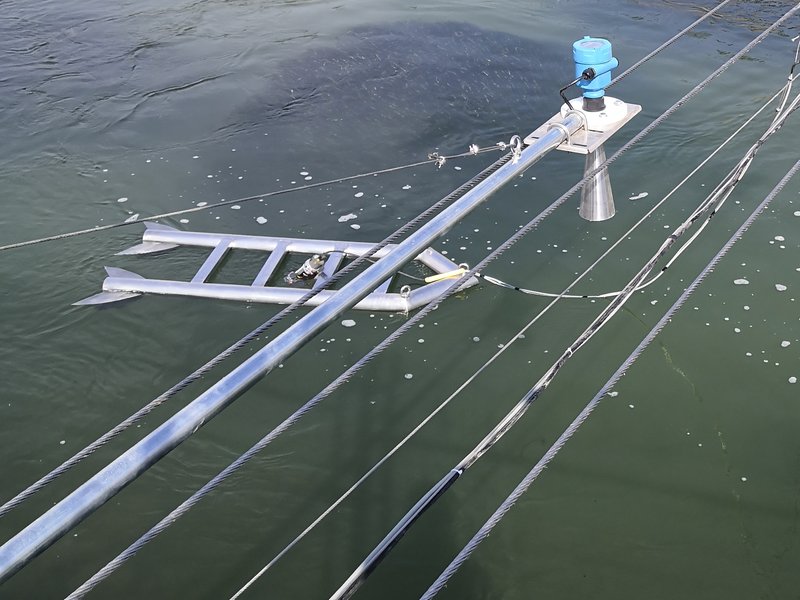
The trade-off is at the far end of the beam: side lobes spoil the cells nearest the bed, and those cells shift as the bed fills or scours.
A wall, pier or abutment: universal horizontal mount
The cylindrical Lodestar-U mounts in any orientation, so the installer's bracket can hold it on a canal wall, pier or abutment, or off the bed where some sediment collects. On a wall it usually runs roughly level. Its beam must still be angled along the channel through the main body of flow, clear of the structure's wake, striking nothing before the bed, the surface or the far wall. A beam that runs roughly level belongs near mid-depth, with its far cells checked at the lowest water level. It must go back exactly after service, so its bracket needs a hard stop or a keyed seat.
Sites where flow reverses
Where water sometimes runs backward, there is no single downstream direction, so let debris and access decide which way the sensor faces. Hold a float fore and aft so it keeps its heading: on a single anchor or line it swings around with the flow, and the reading may never change sign. Your consultant measures the flow running each way. If one rating fits both directions, it serves the site; if not, the rating gets two parts, one per direction, blended smoothly where the flow turns around. This is called a compound rating.
When one line is not enough
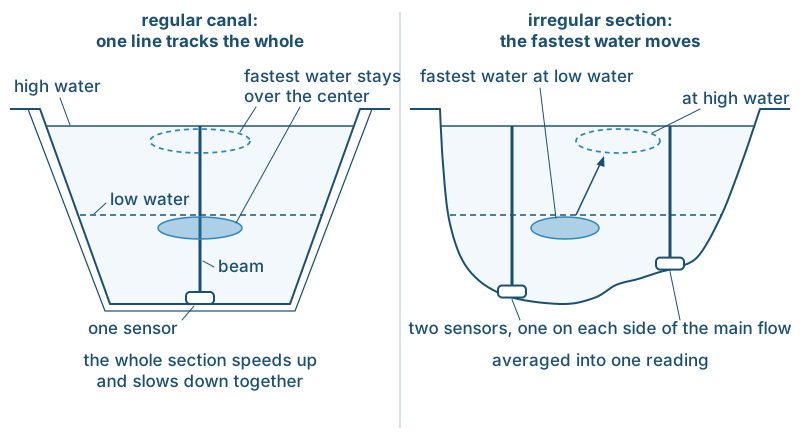
One Lodestar measures along one line through the water. That is like judging a highway's traffic from one lane: it works while all the lanes speed up and slow down together, and stops working once a lane closes. In a straight, regular canal, the water across the channel speeds up and slows down together, and the rating learns how the measured line relates to the whole, so the beam need not reach across the channel. Published guidance cares more that the line's speed rises and falls in step with the whole channel than that the line is long.
Some canals break that pattern. In an irregular cross section, for example one that is deep on one side and shallow on the other, the deep and shallow parts do not speed up and slow down together, and the fastest water moves across the channel as the water rises and falls. One line may then stop tracking the whole channel. At such sites, plan two Lodestars, one on each side of the main flow, unless a straighter, more regular stretch nearby lets one do the job. Averaged with fixed, equal weights into one reading, they keep the rating to one input (one reading the rating uses), so the minimum stays at 10 calibration measurements (the flow measurements the rating is built from), as for one sensor.
For your installer
- Standard configuration: 240 mm long by 75 mm diameter (9.4 in by 3 in), 1.2 kg (2.6 lb). Confirm your configuration's dimensions with HyFlow before fabricating a bracket. HyFlow can propose a bracket design, weed cover included, for you to build. Use non-magnetic fittings near the sensor, so nothing disturbs the compass.
- Cells can be as small as 0.025 m (1 in).
- Power: 12 VDC, about 2 W while sampling.
- Velocity output over RS232 or RS485 serial (RS485 suits long cable runs). Log every cell, and ask us for the output format.
- A separate water-level sensor at or close to the standard cross section, which must be marked for re-survey.
- Cable in conduit or hose, routed clear of debris, on a short run.
- An as-built record: transducer elevation on the stage datum (for a float, its draft and mooring), height above the bed, beam heading and tilt, cable length and a dimensioned sketch.
Unfamiliar term? See the plain-language glossary.
Next step
For a backwater or reverse-flow site, Request a Quote and describe the channel, the bed and the structures you can mount to, so we can quote the right configuration (B, S or U).